AI SEO: Why Being Cited by ChatGPT, Gemini and Claude Matters for Your Business
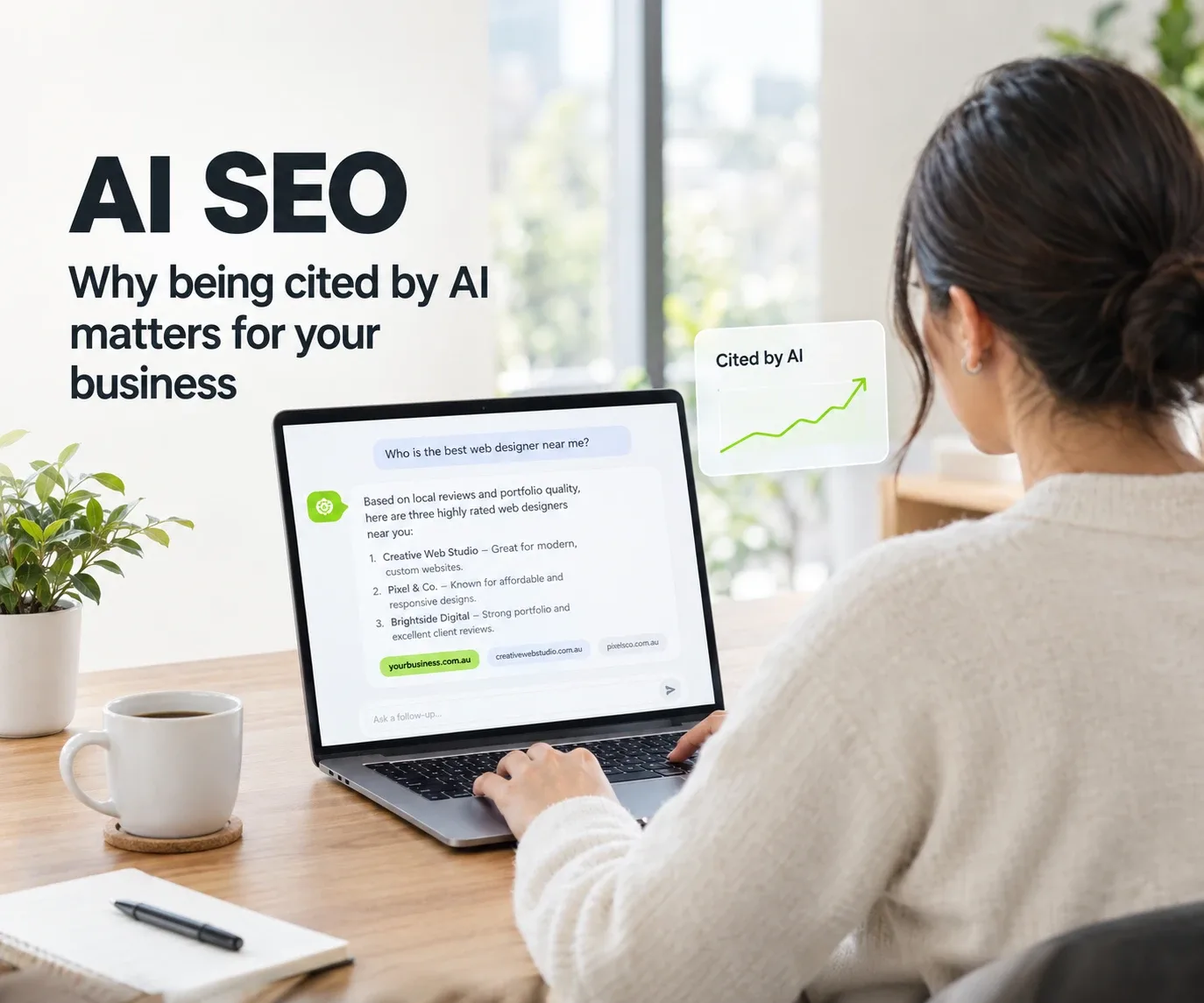
Quick answer: AI SEO is the work of making your business easy for AI tools such as ChatGPT, Gemini, Claude and Google's AI answers to find, understand and cite. It matters because your customers already use them: 58% of Australians aged 14 and over used an AI tool in an average four weeks in early 2026. The realistic result is a small number of visits from people who are close to a decision, plus more people searching for you by name. No one can guarantee a citation.
This guide is for business owners deciding whether AI SEO deserves time or budget. It covers what the term means, the evidence that customers ask AI for suggestions, what results the data supports, what an AI SEO service should include, and what it cannot promise. For the page-by-page method, see our AEO and GEO guide.
What is AI SEO?
AI SEO is search engine optimisation aimed at AI-written answers as well as the normal list of links. The goal is for an AI tool to name your business, quote your page, or link to it when someone asks a question you can help with.
You will also see it called AEO (answer engine optimisation) or GEO (generative engine optimisation). All three names describe the same work. Google's own guide says: "The best practices for SEO continue to be relevant because our generative AI features on Google Search are rooted in our core Search ranking and quality systems" (Google Search Central).
So AI SEO does not replace SEO. It is SEO with three extra questions:
- Can the AI tools' crawlers read your pages?
- Do your pages say clearly enough what you do for an AI tool to repeat it correctly?
- Does the rest of the web say the same thing about you?
Why does AI SEO matter for businesses now?
AI SEO matters because a large share of your customers now ask an AI tool before, or instead of, searching.
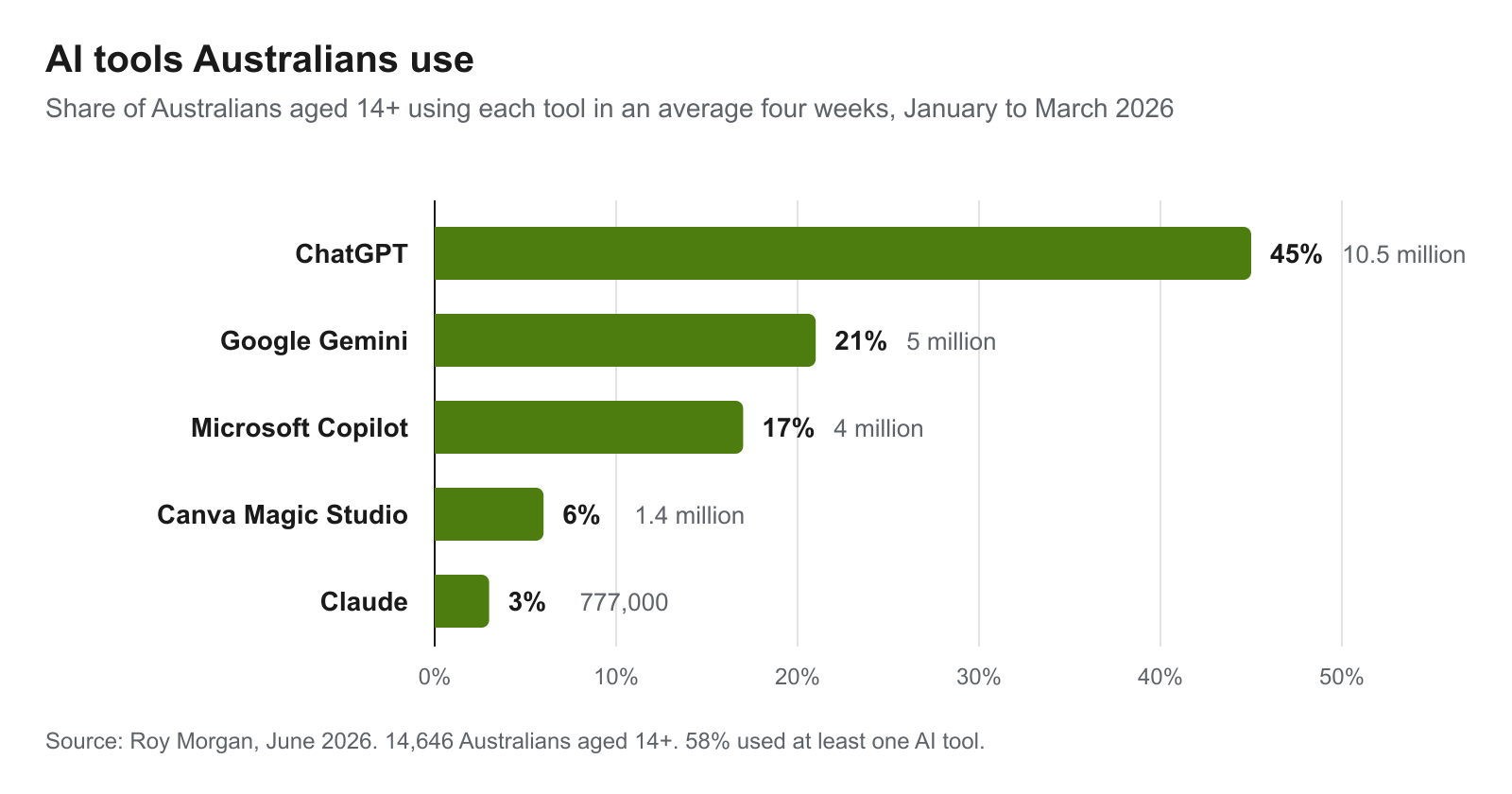
In Australia. Roy Morgan found that 13.6 million Australians, 58% of those aged 14 and over, used an AI tool in an average four weeks between January and March 2026. ChatGPT was used by 45%, Google Gemini by 21%, Microsoft Copilot by 17% and Claude by 3%. Among people aged 25 to 34, the figure for any AI tool was 74% (Roy Morgan, June 2026, based on 14,646 interviews).
A second Australian study points the same way. Telsyte surveyed 2,023 Australians aged 16 and over in April and May 2026 and reported that 12% now name AI tools as their main way of finding information online, up from 5% a year earlier (Telsyte, June 2026).
What they use it for. In the United States, Pew Research Center found that 49% of adults use AI chatbots, and about four in ten adults use them to search for information (Pew Research Center, survey of 5,119 adults, February 2026). A study of ChatGPT conversations by OpenAI and Harvard researchers found that practical guidance, seeking information and writing together made up nearly 80% of all conversations (NBER working paper 34255, September 2025).
What this means for a business. "Which accountant near me handles trusts?" and "What should a five-page website cost?" are now typed into a chat window as well as a search box. The chat window replies with a short answer and a few names. If your business is not one of them, that customer may never see your website.
One limit on this evidence: none of these studies measured how often Australians ask an AI tool to recommend a local business. They show that the tools are widely used for finding information. The step from there to "your customers ask AI who to hire" is a reasonable inference, not a measured figure.
What does being cited by AI mean?
Being cited by AI means one of three things, and they are worth telling apart.
| What the person sees | What it is worth | |
|---|---|---|
| Mention | Your business name appears in the answer | Awareness. Some people search for you by name later |
| Citation | Your page is linked as a source for the answer | A possible visit, and a signal that your page was trusted |
| Recommendation | The tool names you as an option for a need, such as "web designers in Adelaide" | The most valuable of the three, because the person is choosing a provider |
A mention needs the AI tool to know who you are. A citation needs it to have read your page. A recommendation needs both, plus enough agreement across the web that you do what you say you do.
What results can AI SEO deliver?
AI SEO delivers three kinds of result, and it helps to know the size of each before spending on it.
A small number of visits
Visits from AI tools are still a small share of website traffic. Conductor analysed 3.3 billion sessions across 1,215 enterprise websites from May to September 2025 and found that AI tools referred 1.08% of visits, with ChatGPT sending 87.4% of those (Conductor, July 2026). Conductor sells AI visibility software and its sample is large companies, so treat the figure as a guide to scale and not as a forecast for a small business.
Visitors who are closer to a decision
The visits are few, but the evidence suggests they are worth more each.
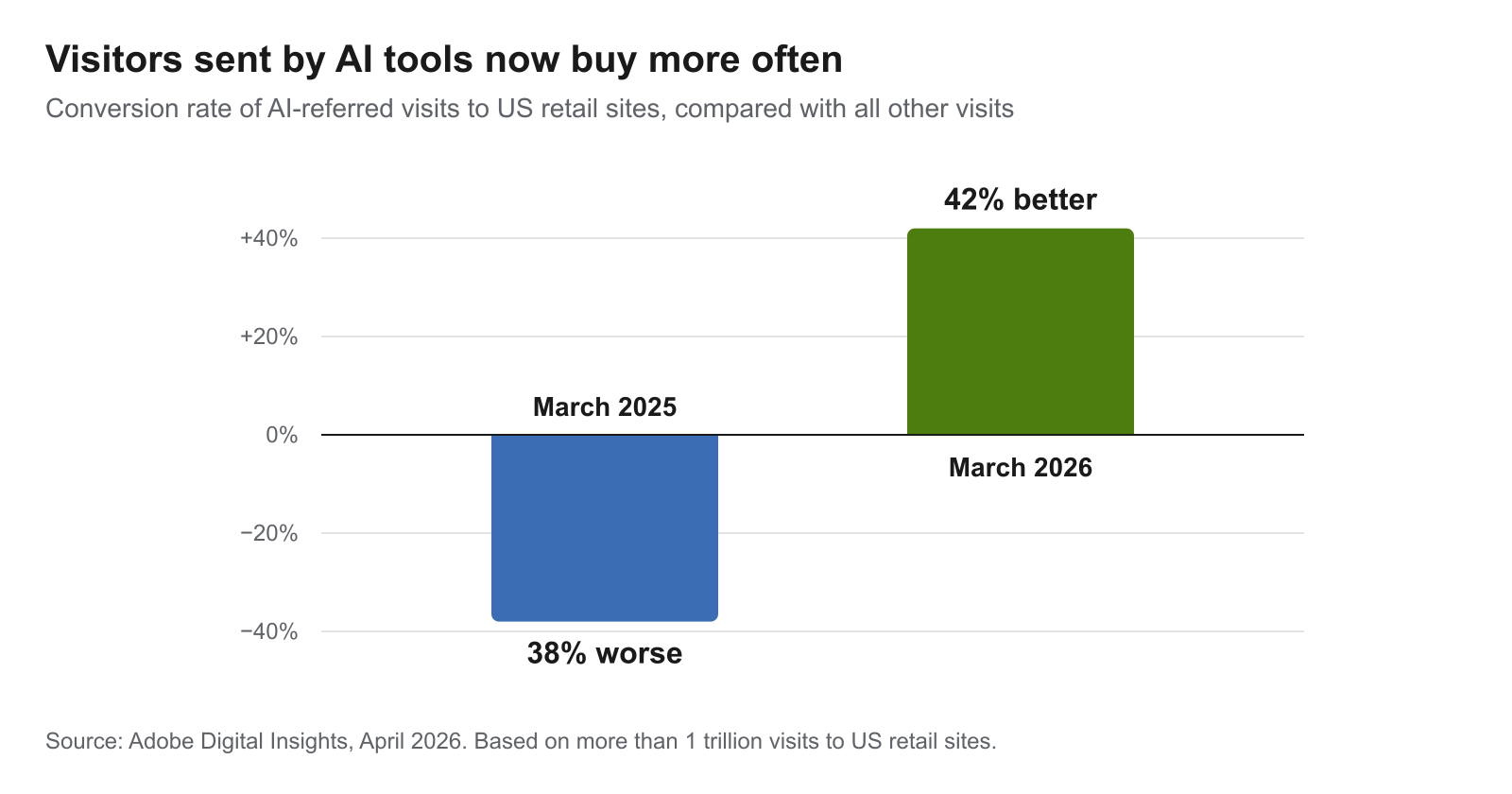
Adobe tracks more than 1 trillion visits to US retail sites. It reported that in March 2026 visits from AI tools converted 42% better than visits from other sources, a reversal from March 2025, when they converted 38% worse. Those visitors also stayed 48% longer and viewed 13% more pages (Adobe, April 2026).
Ahrefs published a more striking figure from its own website: in a 30-day period, AI search sent 0.5% of its visitors and 12.1% of its signups (Ahrefs, June 2025). That is one software company, and the author wrote that he was not sure the result would hold at scale. Use it as an example of what is possible, not as a benchmark.
The likely reason is simple. Someone who has asked an AI tool to compare options has already done their research. When they click through, they are checking a shortlist.
More people who already know your name
Not every result shows up as a click. A person who sees your business named in an AI answer may search for you directly the next day. That appears in your reports as a search for your brand name or a direct visit, with nothing to connect it to the AI answer. This is the hardest of the three results to measure.
What our own numbers look like
In the first three weeks after our own site was indexed, Search Console's generative AI report recorded three impressions. A new or small site should expect numbers like that at the start, and should judge the work over months.
What decides which businesses AI recommends?
No AI company publishes a formula for which businesses it recommends. What is known comes from their documentation and from studies of what the answers contain.
Access. A tool cannot cite a page it cannot read. Google's AI features use Google's normal index. ChatGPT search uses its own crawler, and OpenAI states that sites which block OAI-SearchBot "will not be shown in ChatGPT search answers" (OpenAI). Anthropic and Perplexity run their own search crawlers too.
Clarity. Google describes its AI features as running several related searches for one question and reading the pages they find. A service page that states what you do, who for, where and at what price gives them something exact to repeat. A page of slogans does not.
What other sites say about you. Ahrefs studied 75,000 brands and found that the number of times a brand was mentioned across the web had a strong relationship with how often AI tools named it (a correlation of 0.66 for ChatGPT and 0.71 for Google AI Mode), while link measures such as the number of backlinks showed "very weak correlations" (Ahrefs, December 2025). The study's authors add that "correlation isn't causation", and the brands studied were large. The practical reading is modest: being talked about in the right places appears to matter, and publishing more pages on your own site appears not to. The same study found almost no relationship between the number of pages on a site and its AI visibility.
Something worth quoting. Google asks for content with "unique, expert or experienced takes that go beyond common knowledge and the ordinary". Your own prices, process, results and local knowledge are what an AI answer cannot get anywhere else.
What does an AI SEO service include?
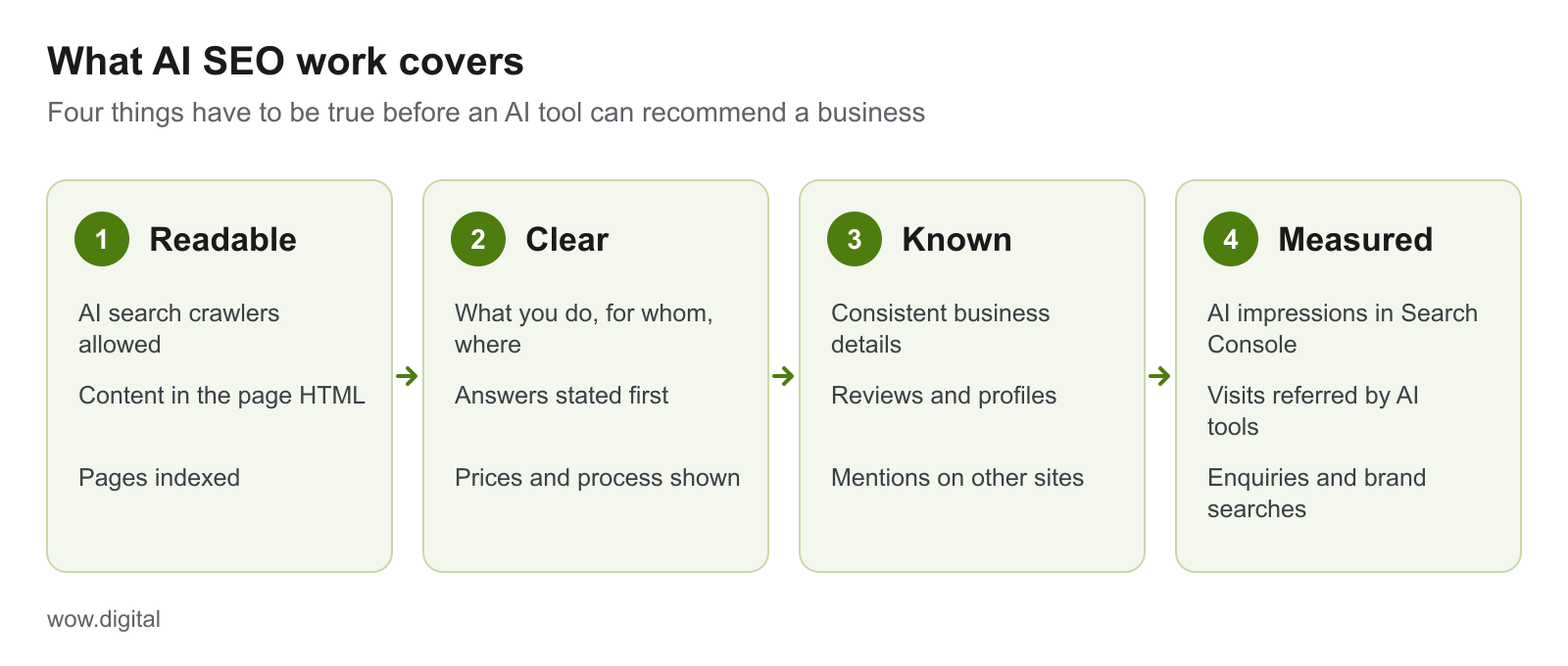
A sound AI SEO service works through four stages in order.
- Readable. An audit of
robots.txtand of whether each page's content is in the HTML or only appears after JavaScript runs, plus a check that the pages are indexed. Adobe scored US retail sites for how much of each page an AI model could read and found product pages averaged 66%, meaning a third of the content was invisible to the tools (Adobe). Our technical SEO checklist covers these checks. - Clear. Rewriting service pages so the answer comes first and the facts are stated in plain text: services, areas served, prices or price ranges, process and proof.
- Known. Making the business consistent wherever it is listed, keeping the Google Business Profile current, earning reviews, and getting mentioned by relevant sites, such as industry bodies, suppliers, local press and directories that people use.
- Measured. A baseline of where the business appears now, then regular checks of AI impressions in Search Console, visits referred by AI tools, enquiries and brand searches.
What an AI SEO agency should not promise
- A guaranteed citation or a top spot in ChatGPT. Nobody controls the answer.
- A special file that gets you cited. Google says no AI text files or special markup are needed for its AI features.
- Hundreds of AI-written pages. Google's spam policies cover content produced at scale to manipulate rankings, and the Ahrefs study above found page count had almost no relationship with AI visibility.
- Results in weeks.
When you compare AI SEO services, ask each provider what they will check, what they will change on your site, and what they will report each month. Our guide to choosing a local SEO agency has a fuller list of questions.
Where should a small business start with AI SEO?
A small business can do the first five steps without paying anyone.
- Ask the tools. Type the questions your customers ask into ChatGPT, Gemini, Claude and Google's AI Mode. Note who is named and which pages are linked. Repeat it a few times, because answers vary.
- Check your
robots.txt. Openyourdomain.com.au/robots.txt. If it blocks everything, or blocks OAI-SearchBot, PerplexityBot or Claude-SearchBot, those tools cannot use your pages. - Fix your main service pages. Each one should say in its first paragraph what the service is, who it is for, where you offer it and roughly what it costs.
- Make your details match. Business name, address or service area, phone number and services should be the same on your site, your Google Business Profile and any directory you are listed in.
- Write down a baseline. Record today's enquiries per month and how many people search for your business name, so you can tell later whether anything changed.
If those five are in place and competitors are still the ones being named, that is the point where a paid AI SEO audit earns its fee.
How do you measure AI SEO results?
Measure AI SEO at three levels, from the easiest to prove to the most important.
| Level | What to look at | Where |
|---|---|---|
| Visibility | How often links to your site appear in Google's AI Overviews and AI Mode | Search Console's generative AI performance report, which shows impressions only |
| Visits | Sessions referred from chatgpt.com, perplexity.ai, gemini.google.com and similar | Your analytics referral report |
| Business | Enquiries, bookings and sales, and searches for your business name | Your own records and Search Console |
Only Google offers a report for the first level. For the other AI tools, a manual check each month, using the same list of questions, is still the most reliable method for a small business. Our guide to Google AI Mode explains what the Search Console report does and does not show.
What can AI SEO not do?
AI SEO has four limits that any honest plan should state.
- It cannot guarantee you are named. The same question can produce different answers for different people.
- It cannot make a weak offer look strong. AI tools repeat what your pages and your reviews say.
- It cannot be measured completely. A share of the benefit arrives as brand searches and direct visits that no report ties back to an AI answer.
- It does not replace ordinary SEO. Google's AI features draw on the same index and the same quality systems as its normal results, so a site that ranks poorly is unlikely to be cited there either.
The short version
- AI SEO means making your business easy for AI tools to find, understand and cite. It is SEO with a wider set of readers.
- It matters now because 58% of Australians aged 14 and over use AI tools, and 12% say AI is their main way of finding information online.
- Expect few visits, better-qualified visitors and more brand searches. Do not expect guarantees.
- Start with access, clear service pages and consistent business details. Mentions on other sites take longer.
- Measure enquiries, not only clicks.
If you would like to know whether AI tools can read your site and what they currently say about your business, get in touch. We check access first, then your service pages, then where you are mentioned, and we tell you plainly which of the fixes you can do yourself.
Work With wow.digital
If you would rather have this handled for you, these pages explain what we do and where we work:
Keep Reading
Frequently asked questions
What is AI SEO?
AI SEO is the work of making a business easy for AI tools such as ChatGPT, Google's AI Overviews and AI Mode, Gemini, Claude and Perplexity to find, understand and cite. It covers whether AI crawlers can read your pages, whether those pages state clearly what you do, and whether the rest of the web confirms it. It is also called AEO or GEO.
Is AI SEO different from normal SEO?
Mostly not. Google says the best practices for SEO remain relevant because its generative AI features are rooted in its core Search ranking and quality systems. AI SEO adds a few checks: access for the AI search crawlers, content that is readable without JavaScript, and tracking of AI impressions and referrals.
How do I get my business recommended by ChatGPT?
Allow OpenAI's search crawler, OAI-SearchBot, in your robots.txt, make sure each service page says plainly what you do, for whom and where, and keep your business details and reviews consistent across the web. Nobody can guarantee a recommendation, and answers differ from one person and one day to the next.
What results can I expect from AI SEO?
Expect a small number of visits at first, from people who are close to a decision. In Conductor's benchmark, AI tools sent about 1% of website visits. Adobe found that in March 2026 visits from AI tools to US retail sites converted 42% better than other visits. Also watch enquiries and searches for your business name.
Can an AI SEO agency guarantee that AI will cite my business?
No. No agency controls what an AI tool says, so a guarantee of citations or of a top recommendation is a warning sign. A good AI SEO service can guarantee the work: what will be checked, what will be changed on your site, and how the result will be measured.
Does AI SEO work for small businesses?
Yes, and the first steps cost nothing. Check that your robots.txt does not block AI search crawlers, state your services, area and prices in plain text, keep your Google Business Profile accurate, and ask the AI tools the questions your customers ask to see who is named.
How long does AI SEO take to show results?
There is no published timeline. A page must be crawled and indexed before it can be cited, and mentions on other sites build slowly. Judge the work over months, using Search Console's generative AI report, visits referred by AI tools, and enquiries.