B2B SEO Case Study: Web Design, SEO and AI Search for a Machinery Exporter
Quick answer: MLBE Power makes farm machinery in China and sells it to importers and dealers in other countries. Its owner told us the old site "barely got a look from overseas buyers". Wow Digital designed and built the new website and handled its SEO and AI search work. Since then MLBE reports about 60% more search impressions, 55% more clicks from search and 50% more enquiries, including enquiries from markets it had not reached before.
This B2B SEO case study sets out who the client is, what the problem was, what we did and why, and what changed. The results are the figures MLBE's owner reported to us in October 2026.
Who is MLBE Power?
MLBE Mechanical & Equipment is a Sino-Australian manufacturer with its factory in Chongqing, China, owned by a Sydney company. It makes power tillers, compact mini tractors, small engines, generators, water pumps, lawn mowers and wood chippers (MLBE Power).
Its customers are other businesses: importers, dealers and distributors who buy in volume and resell in their own country. That makes it a business-to-business (B2B) seller, and it changes what the website is for. Nobody adds a container of power tillers to a shopping cart. The website's job is to get a serious buyer to send an enquiry.
What was the problem?
The problem was reach. In the owner's words: "Before this, our site barely got a look from overseas buyers."
For an exporter, that is close to the whole business. An importer looking for a new supplier starts with a search, in Google or increasingly in an AI tool, for something like a product type plus "manufacturer" or "supplier". If the factory's website does not appear, or appears and does not answer the buyer's first questions, the enquiry goes to a competitor or to a marketplace listing.
What did we do?
Our work covered three things: the website itself, its SEO, and its visibility in AI search.
| Area | What we did |
|---|---|
| Design and build | Full redesign and rebuild on WordPress and WooCommerce, mobile layout, and phone, WhatsApp and email buttons that stay on screen |
| Technical SEO | Schema markup, XML sitemap submitted in Search Console, speed and image optimisation, indexing and crawl errors fixed |
| On-page SEO | Titles and descriptions rewritten, category page copy, buying guides for importers and dealers, product specification tables |
| AI search | FAQ and question-led content, and a check that AI search crawlers can reach the site |
1. A website organised around the buyer's questions
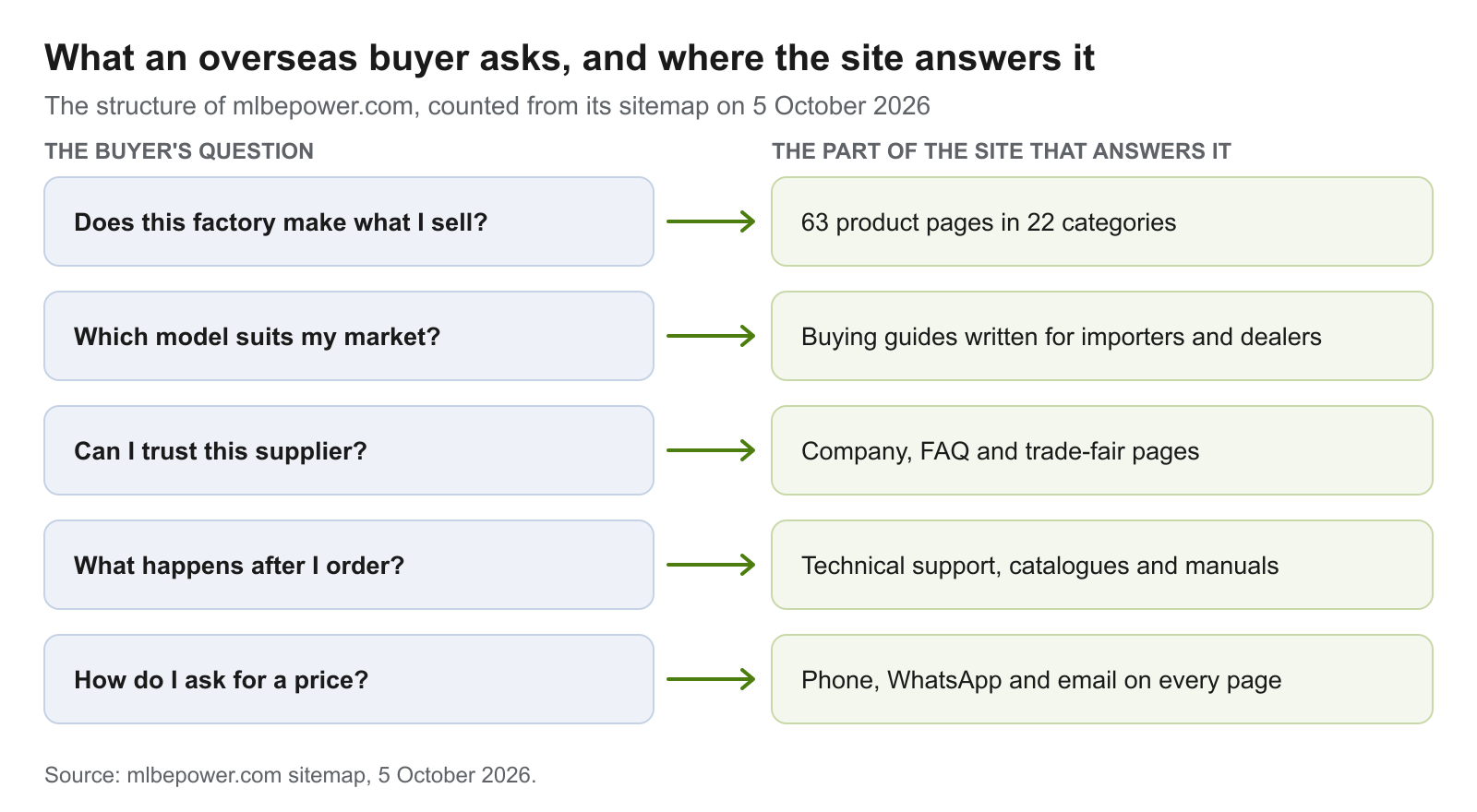
A B2B buyer arrives with a short list of questions, and the site is structured to answer each one. Counted from the site's own sitemap on 5 October 2026, it has 63 product pages in 22 categories, 33 articles and 10 core pages.
- Products are grouped the way buyers search. Each family, such as power tillers, splits by engine type: diesel and gasoline. A dealer who only sells diesel machines can go straight to them.
- Category pages explain, not only list. The power tiller page tells a buyer what to compare: soil condition, engine type, transmission, tilling width and working depth.
- Trust questions have their own pages: the company, an FAQ, technical support, and downloadable catalogues and manuals.
- Contact is one tap away. Phone, WhatsApp and email buttons stay on screen, because overseas buyers often prefer a message to a form.
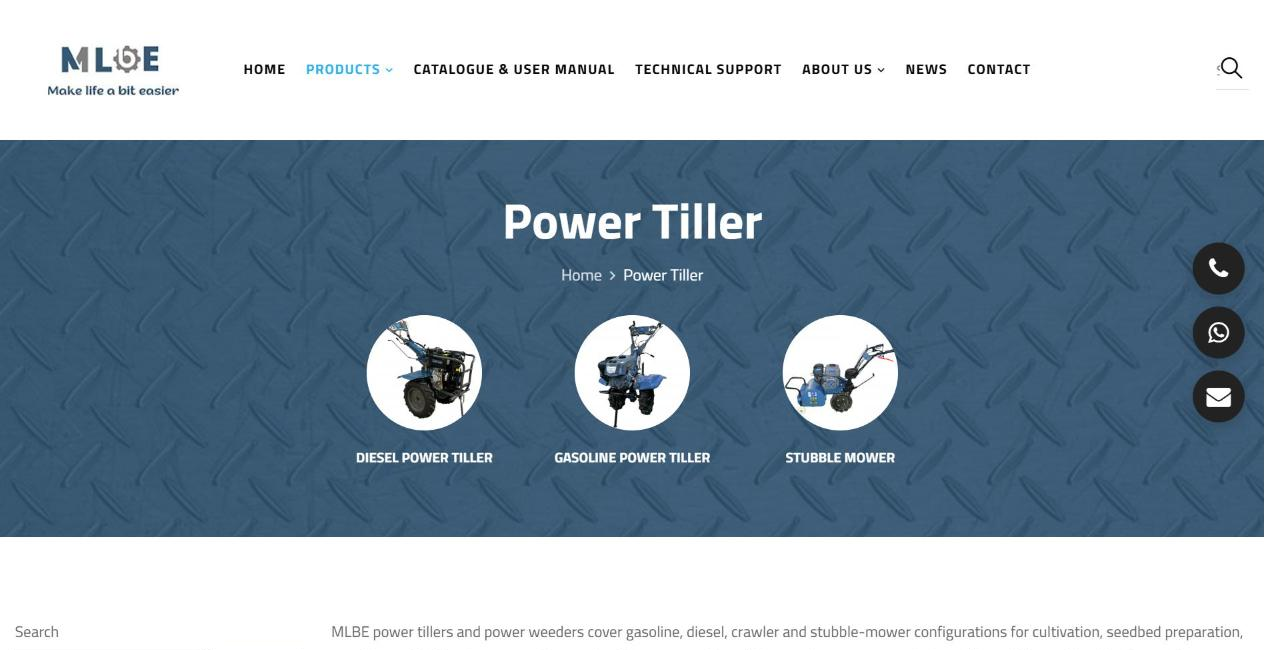
We rebuilt the site on WordPress, with WooCommerce managing the product catalogue. That choice lets MLBE's own team add a product or an article without a developer. The layouts were designed for phones first, since many overseas buyers browse and message from one. Our comparison of WordPress and Shopify explains when each platform fits.
2. B2B SEO: pages for the searches buyers make
B2B SEO differs from consumer SEO in one important way: there are fewer searches, and each one is worth far more. The aim is not traffic. It is the right few hundred people.
- Titles and descriptions rewritten for the buyer. The power tiller category is now titled "Power Tillers for Importers & Dealers", which tells both Google and the buyer who the page is for. A clear title is also what turns an impression into a click.
- Guides for each stage of a purchase. We wrote buying guides for dealers on mini tractors, lawn mowers, wood chippers and generators, and articles on how to evaluate a supplier, minimum order quantities and how to import from China.
- Content for specific markets. Several guides are written for one country's dealers, because an importer in one market searches differently from an importer in another.
- Schema markup. Structured data identifies the organisation, the site and each page's place in it, so search engines read MLBE as one business with a clear catalogue.
- Sitemap and Search Console. An XML sitemap covers products, categories and articles, and is submitted in Google Search Console so new pages are found quickly.
- Indexing and crawl errors fixed. Pages Google could not reach or index were corrected, so the whole catalogue can appear in search.
- Speed and images. Product photos were compressed and pages tuned to load quickly, which matters for buyers on slower connections. Our technical SEO checklist lists the checks we run.
Google's guidance for stores and catalogues is to make sure every product can be reached by following links through categories (Google Search Central). A catalogue with 63 products depends on that.
3. AI search: being readable and quotable
Buyers now ask ChatGPT, Gemini and Google's AI Mode to shortlist suppliers. The work to be included is mostly the same as good SEO, with three extra checks.
- Access. The site's
robots.txtdoes not block AI search crawlers. OpenAI states that sites which block its search crawler "will not be shown in ChatGPT search answers" (OpenAI). - Plain statements of fact. The home page says what MLBE makes, where, and who it sells to. Product pages carry specifications as a text table, down to how many units fit in a shipping container, which an AI tool can quote and a photo cannot.
- Answers to real questions. The FAQ page and each guide answer one question a buyer asks, which is the unit AI search works in. Our guide to AI SEO for business explains why.
Google says no special files or markup are needed to appear in its AI features, and that the same best practices apply (Google Search Central).
What changed?
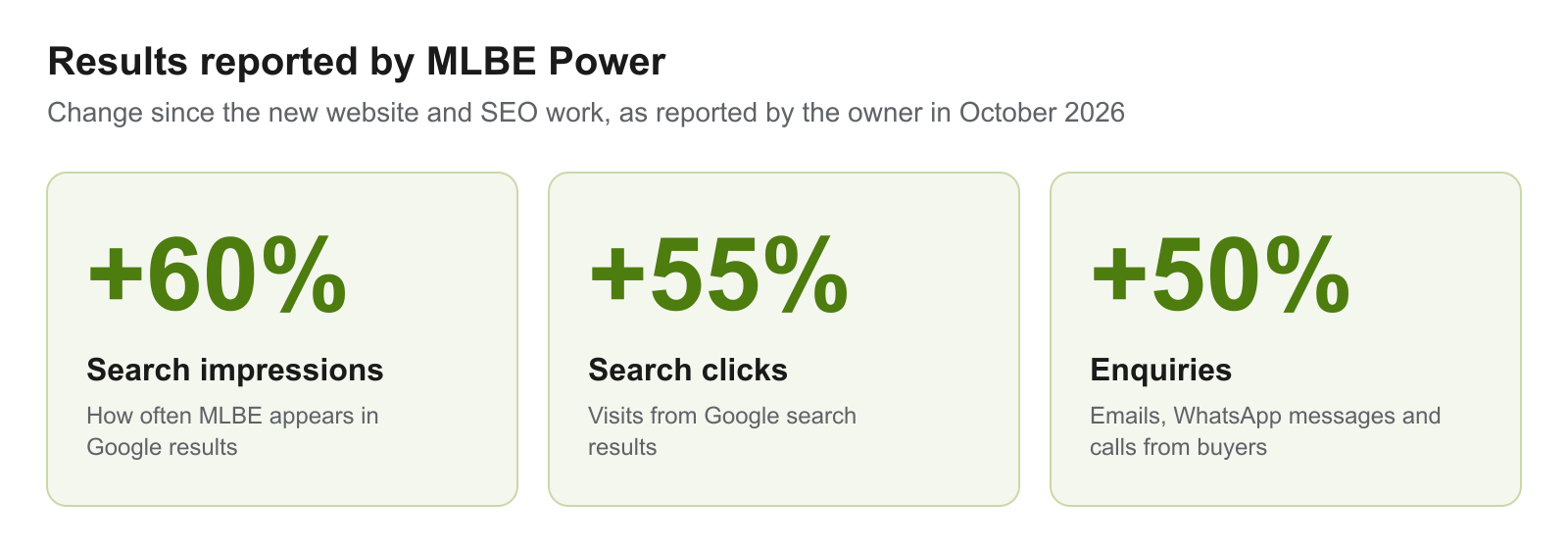
MLBE reports growth in every measure that matters to an exporter since the new website and SEO work.
| Measure | Change reported by MLBE |
|---|---|
| Search impressions | Up about 60% |
| Clicks from search | Up about 55% |
| Enquiries from buyers | Up about 50% |
| New markets | Enquiries from countries MLBE had not reached before |
More visibility, and clicks that kept pace. Appearing in search results is only half the job; the buyer still has to choose your result. Clicks grew almost as fast as impressions, which means the extra visibility was the useful kind: buyers who saw MLBE's pages opened them. Titles and descriptions written for importers and dealers help with that, because a buyer can see at a glance that the page is meant for them.
Clicks became enquiries. The enquiry figure matters most, because it is the one that turns into orders. A site organised around the buyer's questions, with contact one tap away, is what carries a visitor from a product page to a message.
Enquiries from new markets. James, the owner of MLBE Power, put it this way:
"Before this, our site barely got a look from overseas buyers. Now we're getting real enquiries from markets we never used to reach, it's made a genuine difference to the business."
How to read these results
- The figures are MLBE's own. They are approximate and were reported by the owner in October 2026.
- Several changes arrived together. A new website, new content and SEO work launched as one project, so the result belongs to the whole, not to one part.
- AI visibility is ongoing work. AI answers differ from one person and one day to the next, so we check them regularly instead of announcing one result.
What can another B2B business take from this?
- Decide what the website is for. For a B2B seller it is enquiries from the right companies. Design every page towards that.
- Group products the way buyers search, and give each group a page that explains how to choose.
- Write for the buyer's stage. Someone comparing suppliers needs different content from someone ready to order.
- State the commercial terms. Minimum order, lead time and warranty are what a buyer shortlists on.
- Make contact easy in the buyer's preferred channel.
- Let AI search crawlers in, and write facts as text.
- Measure enquiries and their source, then impressions and clicks by page.
Need B2B SEO for your business?
We work with manufacturers, wholesalers and service firms that sell to other businesses, in Australia and overseas. A project starts with a free audit of your current site and a written scope. Get in touch, or see how to choose an agency for the questions to ask us first.
Work With wow.digital
If you would rather have this handled for you, these pages explain what we do and where we work:
Keep Reading
Frequently asked questions
What is B2B SEO?
B2B SEO is search engine optimisation for a business that sells to other businesses. The buyer is usually comparing suppliers, so the work centres on product and category pages, specifications, proof that the supplier is real, and guides that answer a buyer's questions before they enquire.
How is B2B SEO different from SEO for consumers?
Fewer people search, each enquiry is worth more, and the decision takes longer. A B2B site is judged by enquiries from the right companies, not by visitor numbers. Pages need to carry specifications, minimum order quantities, lead times and warranty terms, because a buyer shortlists suppliers on those.
Does SEO work for manufacturers and exporters?
It can, because importers search for suppliers by product, engine type and country of manufacture. A manufacturer needs a page for each product family, written in the buyer's terms, plus content for each market it sells into. Results take months and depend on how competitive the product is.
Can a manufacturer be recommended by ChatGPT or Google's AI answers?
Yes, but nobody can guarantee it. A manufacturer needs pages that AI search crawlers can read, clear statements of what it makes and for whom, and mentions on other sites. AI answers also change from one day and one user to the next, so check regularly instead of relying on one result.
How long does B2B SEO take to show results?
Expect months, not weeks. New pages have to be crawled and indexed, and buyers in a long sales cycle may enquire well after their first visit. Agree at the start what will be measured: enquiries, the markets they come from, and impressions and clicks in Search Console.
What should a B2B SEO agency report on?
Enquiries and where they came from, impressions, clicks and click-through rate by product page and by country, which pages were added or changed that month, and what is planned next. Ask to see the client's own Search Console data, not only the agency's summary.