How Long Does It Take to Build a Website? What Decides the Timeline
Quick answer: We could not find a reliable published figure for how long a small-business website takes to build, so treat any average you are quoted as one company's experience. The timeline is decided by four things: how much is being built, how quickly content and approvals arrive, a few waits that depend on other organisations (domain registration, DNS changes, Google indexing), and whether an existing site is being replaced. The practical answer is to get a written timeline with a date for each stage.
This guide explains each stage, what it waits on, which waits are outside your designer's control, and what to ask a web designer so the dates mean something.
Why is there no standard answer?
We looked for published data on how long website projects take and found very little that applies to a small business.
The closest figures come from government and research bodies, and they describe much larger projects:
- The UK Government's service manual says there is no set length for a discovery phase, the research stage before anything is built, but that around 4 to 8 weeks is typical (GOV.UK Service Manual). It says the prototyping stage that follows tends to last between 6 and 8 weeks (GOV.UK Service Manual). It gives no figure for the build itself.
- Nielsen Norman Group surveyed UX practitioners in October 2019. Of the 242 who answered, 29% said their last discovery took under a week and another 29% said one to two weeks, while 11% said more than eight weeks (Nielsen Norman Group).
Those numbers are about government services and corporate projects with full teams, and the survey is several years old. They show how widely one stage can vary. They do not tell you how long a ten-page site for a plumbing business will take.
The Australian Government's own guide to setting up a business website lists the steps and gives no timeframes at all (business.gov.au).
So treat any "websites take X weeks" claim as one company's experience. What you can rely on is the list of stages and what each one waits for.
What are the stages of a website project?
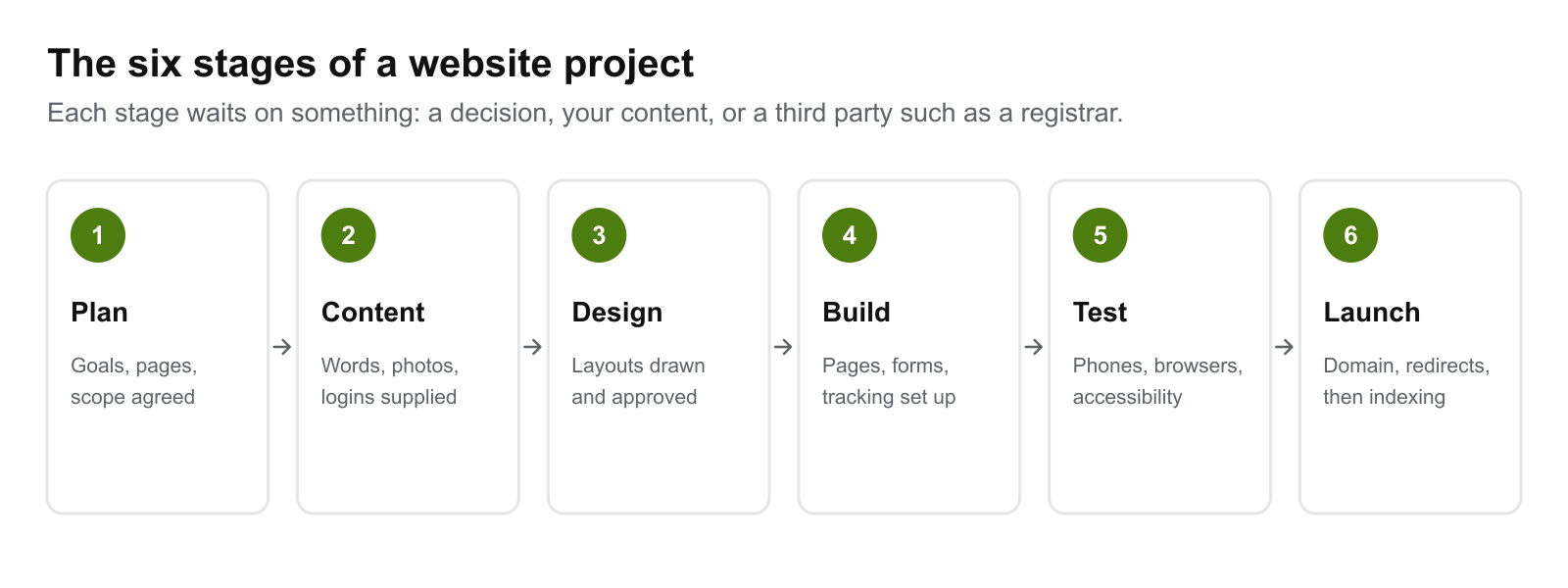
The six stages below are our own grouping of the steps in the business.gov.au guide.
| Stage | What happens | What it waits on |
|---|---|---|
| 1. Plan | Goals, page list, features and scope are agreed | Your decisions |
| 2. Content | Words, photos, logos, logins and policies are gathered | You, or a copywriter and photographer |
| 3. Design | Layouts are drawn and revised | Your feedback and approval |
| 4. Build | Pages, forms, tracking and any store or booking features are built | The designer or developer |
| 5. Test | The site is checked on phones and browsers, and for accessibility | Both of you |
| 6. Launch | Domain is pointed at the new site, redirects go live | Registrars, DNS and search engines |
In this breakdown, only one of the six stages depends mainly on the person you are paying. The other five wait on decisions, content or third parties, which is how two projects with the same page count can take very different lengths of time.
Plan
This stage sets everything after it. The page list, the must-have features and the things that are out of scope should all be written down. The UK service manual describes sorting requirements into must have, should have, could have and will not have, with must-haves being the things the product cannot function without (GOV.UK Service Manual). The same method works for a small website. Our guide to writing a website brief has a template.
Content
Every page needs words and most need images. If you are writing the content yourself, this is work you do alongside running the business. If a copywriter is writing it, they still need your input on services, prices and what makes you different.
Gather these early, because the build cannot finish without them: logins for your domain registrar and any existing website, your logo files, photos of real work, and the wording of your privacy policy, terms and returns policy if you sell online.
Design
The designer produces layouts and you respond. Each round of feedback is a wait. Nielsen Norman Group observes, of large redesigns, that ambitious timelines can be stretched by long debate among the people involved (Nielsen Norman Group). Naming one person who makes the final call keeps this stage short.
Build
This is the stage most people picture, and it is the one most within the developer's control. It grows with the number of page templates and with features such as a store, a booking system, a members' area or connections to other software.
Test
Testing covers more than checking that links work. The business.gov.au guide lists navigation, purchasing, broken links, different browsers and devices, and a final review of all content. The W3C advises evaluating accessibility early and throughout development, and notes that no tool alone can determine whether a site meets accessibility standards (W3C Web Accessibility Initiative). That means a person has to check, which takes time that should be in the plan.
Speed belongs here too. Google's Core Web Vitals give targets to test against: the main content should load within 2.5 seconds, the page should respond to input within 200 milliseconds, and layout shift should score 0.1 or less (web.dev). Our page speed case study shows what fixing those involved on our own site.
Launch
Launch is a sequence of steps: pointing the domain at the new site, switching on redirects from any old addresses, and asking search engines to crawl it. Several of those involve other organisations, and the next section covers how long they can take.
Which waits are outside your designer's control?
Some steps depend on other organisations, whoever builds the site. The published figures below are upper limits and ranges, not fixed waits.
| Step | Published timeframe | Source |
|---|---|---|
| A new .au domain name being ready for use | Up to two days | auDA |
| DNS changes taking effect | Up to 48 hours on Shopify; depends on how long old records are cached | Shopify Help Center, Cloudflare |
| Google noticing a new site | It can take a few weeks | Google Search Central |
| Google crawling new or changed pages | A few days to a few weeks | Google Search Central |
| Most pages of a small to medium site moving to new addresses in Google | A few weeks | Google Search Central |
Two practical points:
Register the domain at the start, not at the end. For a .com.au name the usual way to qualify is an active ABN or ACN (business.gov.au). A new business needs that in place before it can register the name.
Launch day is not the day customers find you on Google. A site can be live and working while search engines are still discovering it. Google says some changes take effect in a few hours and others could take several months (Google Search Central). Visitors from ads, referrals and people typing your address can arrive on day one. Plan any launch promotion around those, not around search.
Does replacing an existing website take longer?
Yes, because it adds a job a new site does not have: making sure the old site's search visibility carries over.
Google's guidance on moving a site describes four steps: prepare and test the new site, map each old address to its new one, set up redirects, and monitor both sites afterwards (Google Search Central). It also says to expect temporary fluctuation in ranking during the move and to keep redirects in place for generally at least a year.
On a site with a few dozen pages, the mapping is a small task. On a store with thousands of product pages, it is a project stage of its own. Either way it should appear in the timeline. A redesign that skips it can lose rankings the old site had earned. Our guide to website redesign versus rebuild covers when each approach fits.
If the hosting is changing as well, Google suggests lowering the DNS cache time at least a week before the move so the switch takes effect quickly (Google Search Central). That is a week of lead time someone has to remember.
What adds time to an online store?
A store has everything a brochure site has, plus products, payments, shipping and legal wording. The items that tend to need decisions from you:
- Product data. Names, prices, variants, stock levels and photos for every product.
- Prices shown in full. A displayed total price must include all charges, taxes, duties, levies and fees (business.gov.au).
- Returns and refund wording. Store policies cannot override the consumer guarantees under Australian Consumer Law (business.gov.au), so the wording needs checking before launch.
- Terms and conditions. The Government's ecommerce guidance says to make them clear, accurate and easy for customers to find (business.gov.au).
- Payment and shipping setup. Payment providers and carriers each need an account set up before the store can take orders.
This is general information, not legal advice. Our guides to what matters in ecommerce website development and Shopify versus WooCommerce go further into store builds.
How do you get a timeline you can rely on?
Ask for it in writing, and ask for more than an end date. A useful timeline has:
- A date for each stage, not one delivery date.
- What the designer needs from you before each stage, with its own date. For example, if your content is due on the 10th and arrives on the 24th, the launch is likely to move by about two weeks, and both sides should know that in advance.
- How many rounds of design feedback are included, and how long you have to respond to each.
- Who approves each stage on your side. One name.
- What happens when scope changes. New pages or features added midway should come with a new date as well as a new price.
- The launch steps and who does each one: domain, DNS, redirects, submitting the site to Google.
- What is not included. Copywriting, photography, and ongoing SEO are common gaps.
If a designer cannot produce this, ask why before you sign. Our own stages are set out on the Web Design Adelaide page, and our guide to choosing a web development agency lists other checks worth making before you sign.
How can you shorten a website project?
Several of the stages wait on you, so these are the steps within your control:
- Decide the page list before work starts. Changes after design begins mean redoing work.
- Have the content ready, or decide who is writing it. Agree on a date and treat it like any other business deadline.
- Hand over logins early. Domain registrar, current website, Google Business Profile, analytics.
- Give feedback once per round. Collect everyone's comments, resolve disagreements internally, and send one list.
- Launch with the must-haves. A blog, extra page templates and nice-to-have features can follow after the site is live and earning enquiries.
- Start accessibility and speed checks early. The UK service manual notes that problems usually cost less to fix if you find them early (GOV.UK Service Manual).
Planning a website in Adelaide?
Our Web Design Adelaide service runs each project through the stages above, from discovery and page structure to testing and launch. For a first website, see small business web design. If you want a sense of cost alongside timing, our Adelaide website pricing guide has the 2026 price bands. Get in touch and tell us your launch date, and we can talk through whether it is realistic.
Work With wow.digital
If you would rather have this handled for you, these pages explain what we do and where we work:
Keep Reading
Frequently asked questions
How long does it take to build a website?
It depends on the scope and on how quickly content and approvals arrive, and we could not find a reliable published figure for small-business websites. Ask the designer for a written timeline with a date for each stage and a list of what they need from you before each one. That is more useful than any average.
What takes the longest when building a website?
We could not find a published ranking of causes. The stages that depend on other people are the ones a developer cannot speed up: writing and supplying content, approving designs, and getting access to domains and existing accounts. Nielsen Norman Group notes that timelines on large redesigns can be stretched by long stakeholder debate.
How long does a domain name take to work?
A new .au domain name can take up to two days to be ready for use, according to auDA. Changes to DNS records then depend on how long the old records are cached. Shopify, for example, says DNS updates can take up to 48 hours on its platform.
How long after launch will my website appear on Google?
Google says it can take a few weeks for it to notice a new site, and that crawling can take anywhere from a few days to a few weeks. Appearing in Google is not the same as ranking well: Google says some changes take effect in hours and others take several months.
Does replacing an existing website take longer than building a new one?
It adds work that a new site does not have: mapping every old address to its new one, setting up redirects and monitoring after launch. Google says a small to medium site can take a few weeks for most pages to move in its index, and recommends keeping redirects for generally at least a year.
How can I make a website project go faster?
Decide the page list and the must-have features before work starts, supply content and logins early, name one person to approve each stage, and give feedback in one round rather than several. A written brief covers most of this.
Can a website be built in a week?
It depends on what is ready beforehand. The build is one stage of six. If the content is written, the decisions are made and the domain is registered, a small template site has little left to wait on. If they are not, a fast build does not make up for it.