Lead Generation Website: How to Get Leads From Your Website
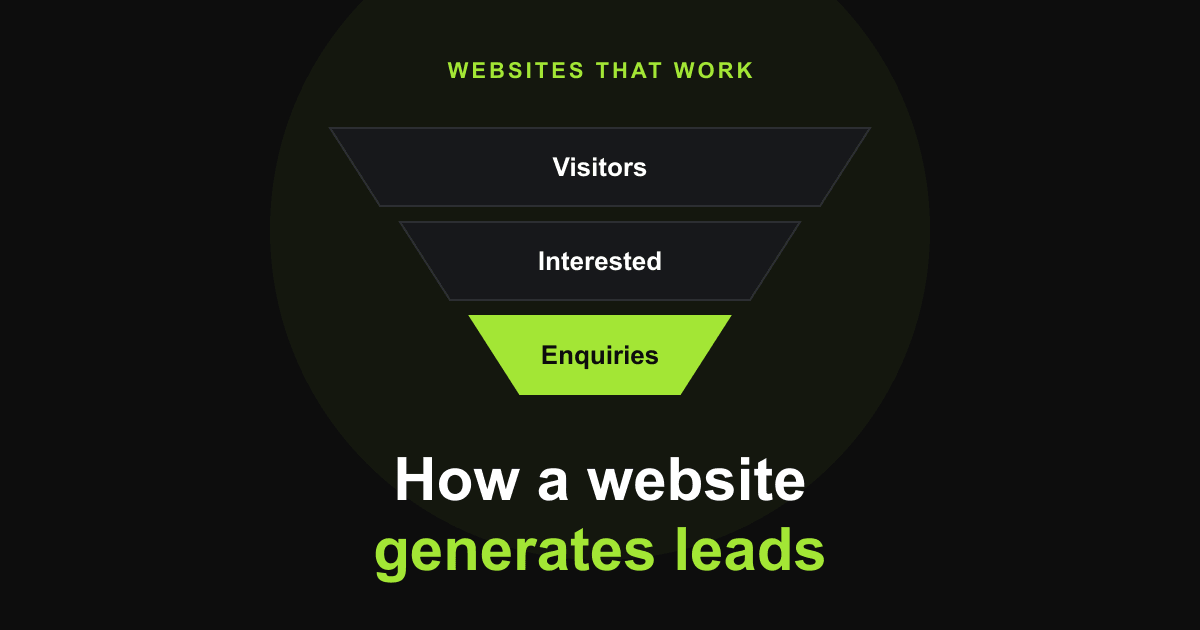
Quick answer: A website generates leads when four things are true: the right people can find it, each page says quickly what you do and where, the page gives them reasons to trust you, and there is one clear way to get in touch. A lead generation website is a site designed around those four steps, with a fifth step behind the scenes: replying fast and keeping a record.
Most websites that "don't bring in any work" fail at one specific step. This guide goes through each one, what it needs, when a lead generation agency is worth paying for, the Australian rules on collecting contact details, and how to measure whether website lead generation is working.
What is a lead generation website?
A lead is a person who has asked to be contacted or has contacted you: a phone call, a form, a booking, a quote request. A lead generation website is built to produce those, as opposed to a brochure site that only describes the business.
The difference is in three habits:
- Every page has one main action it wants the visitor to take.
- The business knows how many enquiries each page produces.
- Pages are changed when the numbers show they are not working.
A lead generation website does not need tricks, pop-ups or pressure. It needs to be easy to find, easy to understand and easy to contact.
How does a website turn a visitor into a lead?
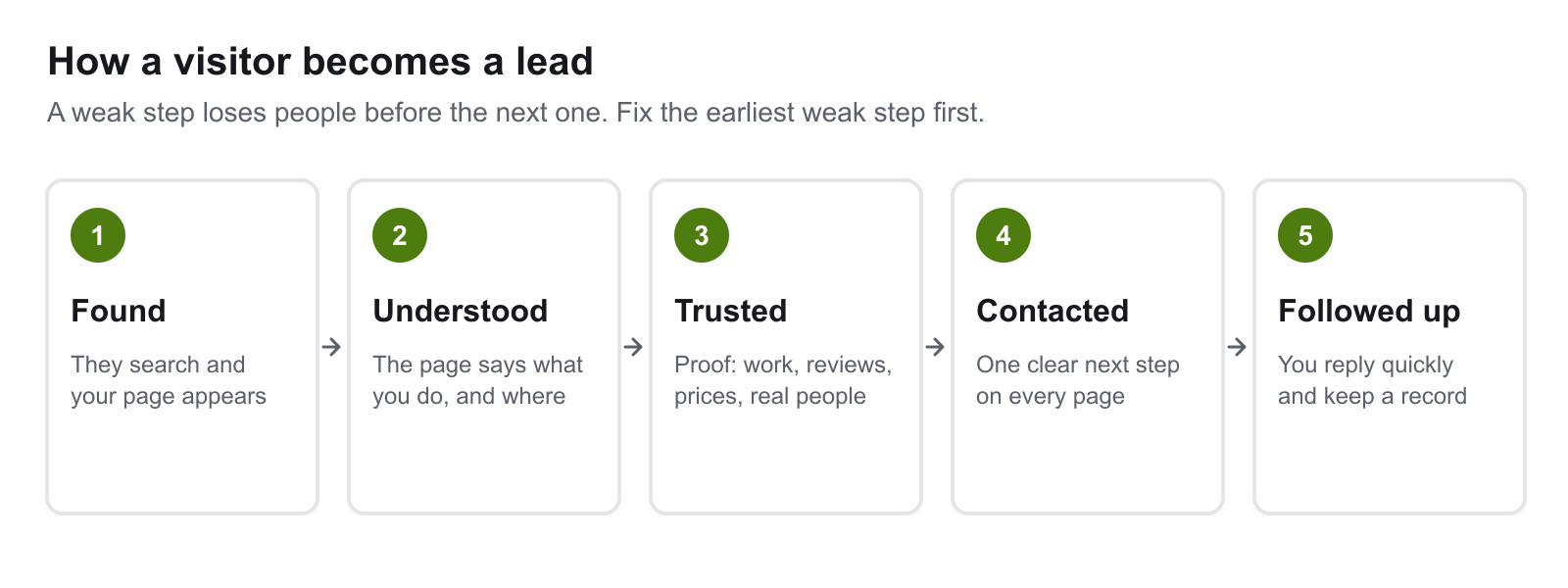
Each step filters people out. If the first screen does not say what you do, visitors leave before they ever see your reviews. So the useful question is not "how do I get more leads" but "which step is losing people".
Step 1: Found
Visitors arrive from search, ads, social media, directories, referrals and people typing your name. Search is the one that depends most on how the site is built.
- One page per service. A page about "bathroom renovations" can appear for that search. A single "Services" page listing ten things rarely appears for any of them.
- Say where you work. Suburbs, city or regions, in the text of the page.
- Make sure the pages can be indexed. Our technical SEO checklist covers the checks.
- Keep your Google Business Profile accurate and linked to the site, since it is what appears in Maps and local results.
Step 2: Understood
A visitor decides within the first screen whether they are in the right place. That screen should answer three questions without scrolling: what you do, who for, and where.
Compare "Solutions for a changing world" with "Commercial electricians for shops and offices across Adelaide". The second loses nobody who was looking for it.
Step 3: Trusted
Before contacting a business they do not know, people look for evidence. The most useful kinds are the ones a visitor can check:
- photos of real, recent work, not stock images
- reviews with names, and a link to where they were left
- licences, qualifications, insurance and memberships
- prices, price ranges or a clear explanation of how you quote
- the people behind the business, by name
Make only claims you can support. "Adelaide's best" persuades nobody. "Licensed since 2012, licence number shown below" does.
Step 4: Contacted
This step is usually the quickest to fix.
| Element | What works |
|---|---|
| Phone number | At the top of every page, and tappable on a phone |
| Form | As few fields as you need to reply: name, contact detail, what they need |
| Button wording | Says what happens: "Get a quote", "Book a call", not "Submit" |
| After the form | A message saying when they will hear back, and how |
| Placement | The main action near the top of the page and again at the end |
| Choice | One main action per page; a second, lower-commitment option is fine |
Every extra form field gives someone a reason to stop. Ask later for anything you do not need in order to reply.
Step 5: Followed up
The website's job ends when the enquiry arrives. Yours starts. Reply the same day where you can. Someone who has filled in your form has often contacted another business as well.
- Send form enquiries to an inbox someone reads every day.
- Test the form yourself after every change to the site.
- Keep a simple record: date, source, what they wanted, what happened.
What pages does a lead generation website need?
The same pages as any good business site, each with a job in the five steps.
- Home: who you are, what you do, where; routes people to the right service.
- Service pages: one per service, each with its own proof and its own call to action.
- About: the people, the history, the licences.
- Proof: case studies, portfolio, reviews.
- Contact: every way to reach you, hours and service area.
Our guide to website design packages in Australia covers which pages each tier includes, and how design affects conversion rate covers the layout decisions.
Lead generation website or lead generation agency: which do you need?
A lead generation agency in Australia typically does one of two things: it runs campaigns that send traffic to your site (search ads, social ads, SEO), or it generates leads itself and sells them to you. Both can work. Neither fixes a website that does not convert.
| Your situation | What to do first |
|---|---|
| Few visitors, and those who come do enquire | More traffic: SEO or ads, in-house or through an agency |
| Plenty of visitors, few enquiries | Fix the website: steps 2 to 4 above |
| Few visitors and few enquiries | Fix the website, then buy traffic |
| You buy leads from a third party | Check the cost per customer, not per lead, and whether those leads are shared with competitors |
If the website is the weak point, the provider you need is a web design agency that plans pages around enquiries, not one that only sends traffic. Ask a website design agency how it will measure enquiries after launch, and which pages it expects them to come from.
Before hiring a lead generation agency, ask what counts as a lead in its reports, who owns the ad accounts and the data, what the minimum term is, and how it will show which leads became customers. Our guide to choosing a local SEO agency has a fuller list of questions that apply to any marketing agency.
What are the rules for collecting leads in Australia?
Collecting contact details through a website carries obligations. Two regulators matter most.
Marketing messages: the Spam Act. The Australian Communications and Media Authority sets three requirements for commercial emails and texts: you need the person's consent, the message must identify you and include your contact details, and it must make it easy to unsubscribe (ACMA). ACMA describes express consent, such as ticking a box on a website form, as best practice, and notes that it is up to the business to prove consent. An unsubscribe request has to be honoured within five working days.
In practice: replying to someone's enquiry is answering them. Adding them to a newsletter is marketing, and needs its own consent. An unticked box on the form, with plain wording, covers it.
Personal information: the Privacy Act. Whether the Act applies depends on the business, and the Office of the Australian Information Commissioner publishes guidance for small business. Whatever your position, a short privacy policy that says what you collect, why, and who sees it is good practice and something customers look for.
This is general information, not legal advice. Check the regulators' pages for your own situation.
How do you measure whether a website is generating leads?
Count enquiries, and know where each came from.
| What to measure | Where to find it | What it tells you |
|---|---|---|
| Enquiries per month | Your inbox, call log or CRM | The result that matters |
| Enquiries by page | Form tracking in your analytics | Which pages earn their place |
| Visits by source | Analytics | Where visitors come from |
| Searches you appear for | Google Search Console | Whether the right people can find you |
| Enquiries that became customers | Your own records | Whether the leads are any good |
Divide enquiries by visits for a rough conversion rate, then compare pages with each other. Do not judge your site against a published "average conversion rate". Those figures vary widely by industry and by what each study counts as a conversion, and your own trend over time is the useful measure.
Expect the search numbers to start small. In the first three weeks after our own site was indexed, Search Console showed 872 impressions and 6 clicks. Leads from search build over months. Leads from referrals, ads and existing customers can arrive as soon as the site is live.
Why a website gets visitors but no leads
If people are arriving and nobody is enquiring, check these in order:
- Are they the right visitors? Traffic for the wrong searches will never convert.
- Does the first screen say what you do and where?
- Is there proof a stranger can check?
- Can they contact you in one step on a phone? Try it on your own phone.
- Does the form work? Send yourself a test.
- Is the site fast enough? Our page speed case study shows how much a slow page can hide.
Want a website that brings in enquiries?
Our Web Design Adelaide service plans each page around the five steps above, and our small business web design service does the same for smaller sites. Get in touch and tell us where your enquiries come from today.
Work With wow.digital
If you would rather have this handled for you, these pages explain what we do and where we work:
Keep Reading
Frequently asked questions
What is a lead generation website?
A lead generation website is a site built so that visitors contact the business: by phone, form, booking or quote request. It differs from a brochure site in that every page has one clear next step and the business measures how many enquiries each page produces.
How does a website generate leads?
In five steps. People find a page through search, ads or a referral. The page tells them quickly what you do and where. It gives them reasons to trust you. It offers one clear way to get in touch. Then you reply quickly. A weak step loses visitors before they reach the next one.
How many leads should a website generate?
There is no reliable universal figure, because it depends on the industry, the price of the service, where visitors come from and what you count as a lead. Measure your own site: enquiries divided by visits, by page and by traffic source, and work on improving that figure over time.
What is the best call to action for a service business website?
The one that matches what the visitor is ready to do. For urgent services, a phone number that can be tapped. For considered purchases, a short form or a quote request. Offer one main action per page, repeat it, and say what happens after they use it.
Do I need a lead generation agency or a better website?
Fix the website first if visitors arrive and do not enquire. An agency that sends more traffic to a page that does not convert only raises the cost of each lead. Once the site turns visitors into enquiries at a steady rate, paying an agency for more traffic makes sense.
Do I need consent to email people who fill in my website form?
To send marketing messages, yes. Under Australia's Spam Act you need the person's consent, your messages must identify you and include your contact details, and every commercial message needs a working unsubscribe option. Replying to the enquiry they sent is a different matter from adding them to a marketing list.
How long does it take for a new website to generate leads?
From search, usually months, because search engines take time to find and rank a new site. Leads from ads, referrals and existing customers can arrive as soon as the site is live, since those visitors do not depend on search rankings.