AEO vs GEO vs AI SEO: What's the Difference and Which Do You Need?
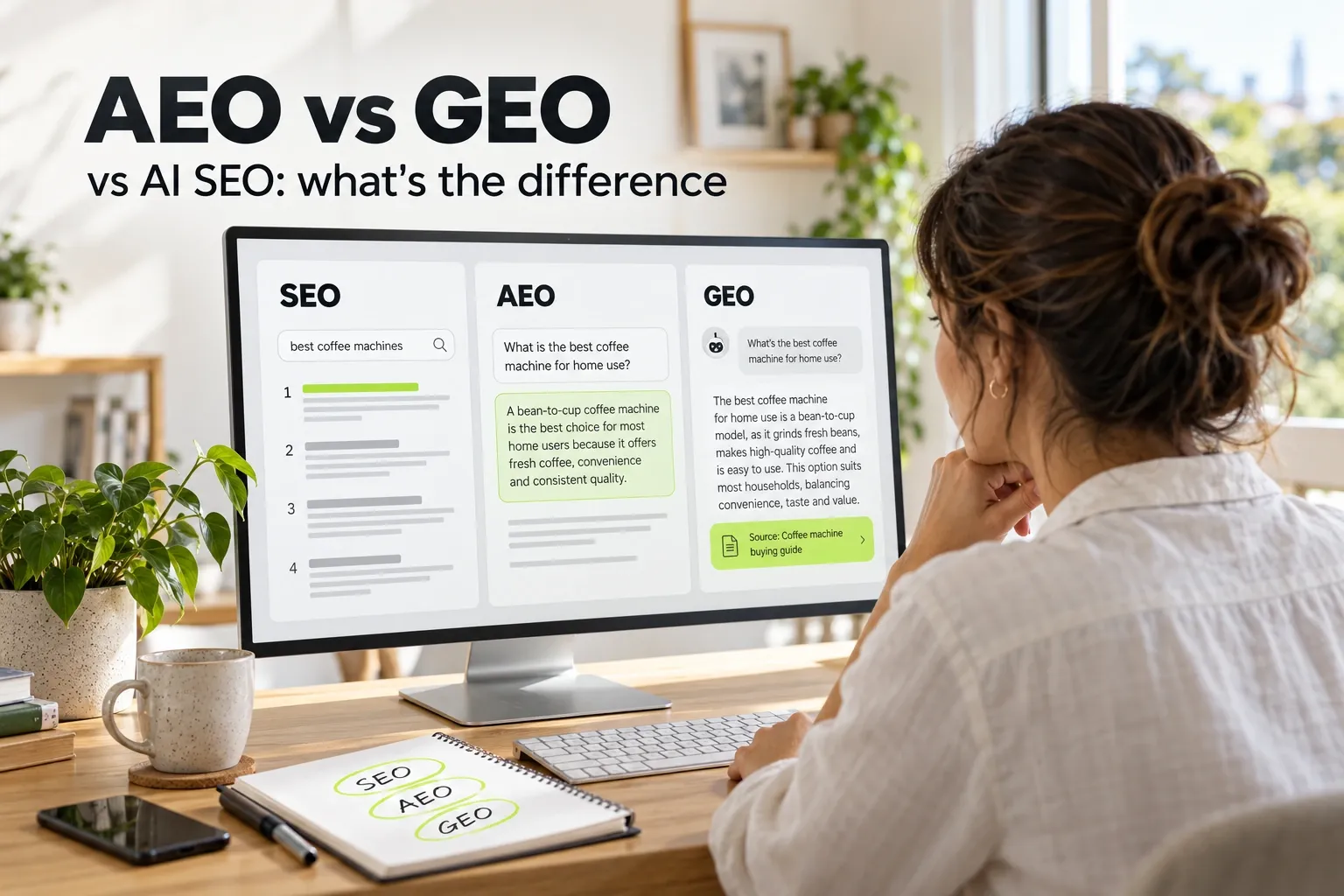
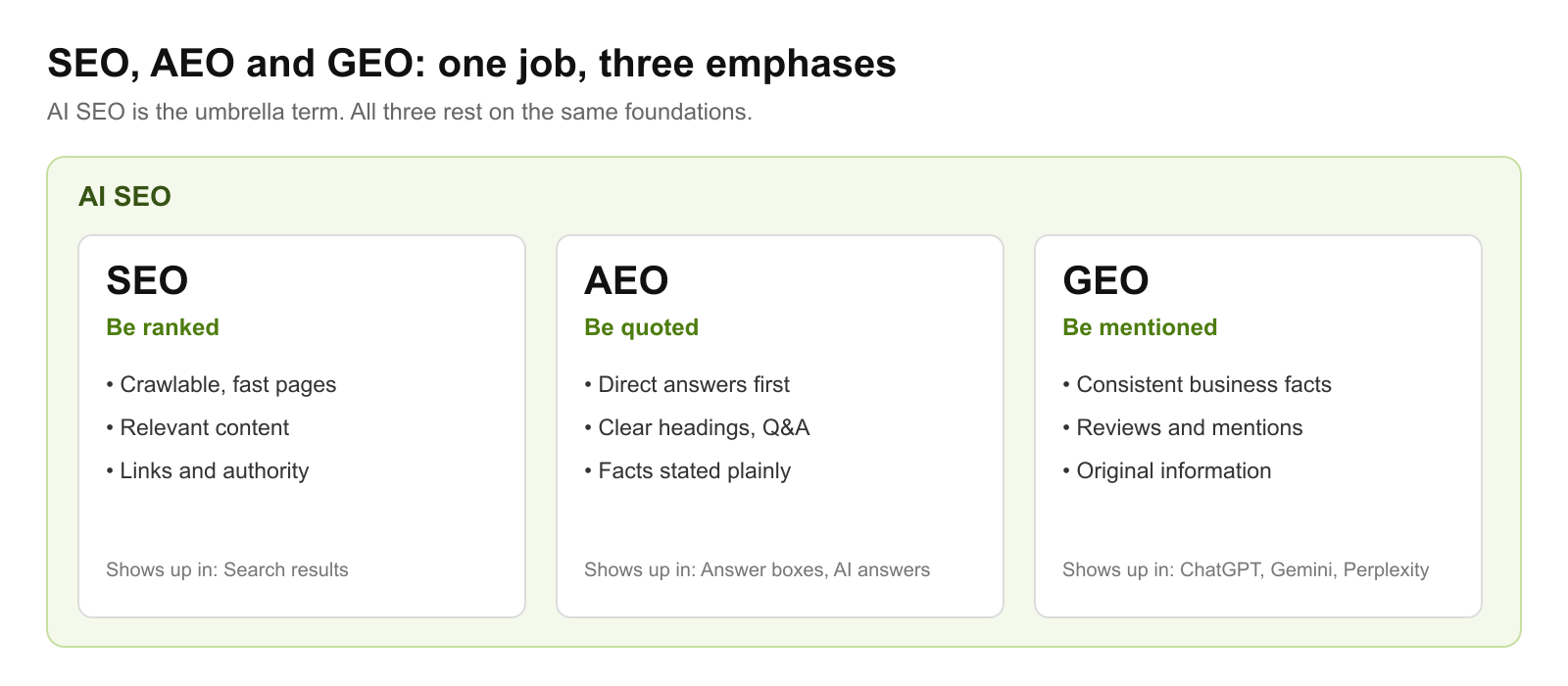
Quick answer: AEO (answer engine optimisation) is about being quoted: structuring pages so a search feature or AI tool can lift a direct answer from them. GEO (generative engine optimisation) is about being mentioned: earning a citation inside answers written by ChatGPT, Gemini, Perplexity or Google's AI Overviews. AI SEO is the umbrella term for both. All three rest on ordinary SEO, and Google's own guidance says optimising for generative AI search "is optimizing for the search experience, and thus still SEO".
If you are comparing agencies, you will see all three terms, sometimes on the same page. This guide sets out what each one means, where the terms came from, how they compare with SEO, and what you should actually pay for.
AEO vs GEO vs AI SEO at a glance
| SEO | AEO | GEO | AI SEO | |
|---|---|---|---|---|
| Goal | Be ranked | Be quoted | Be mentioned or cited | All of these |
| Where it shows | Search results | Featured snippets, voice answers, AI answers | ChatGPT, Gemini, Perplexity, AI Overviews | Google and AI tools |
| Main work | Crawlable pages, relevant content, authority | Answer-first writing, clear headings, plain facts | Consistent business facts, reviews, mentions, original information | The combined job |
| Origin of the term | Long-standing | Became common in the featured snippet and voice era (around 2017 to 2018) | 2023 research paper | Industry umbrella term |
What is AEO?
Answer engine optimisation means making a page easy to use as a direct answer. The idea grew out of featured snippets and voice assistants. When Google re-explained featured snippets in January 2018, it said "with featured snippets, we reverse the usual format", putting the answer before the link, and noted they are "especially helpful for those on mobile or searching by voice". No one has authoritatively documented who coined "AEO", but the term became common around then.
In practice, AEO is answer-first writing: state the answer in the first sentence or two, use headings that match the questions people ask, and put facts such as prices, locations and opening hours in plain text rather than images or scripts.
Compare a page that opens "We have been proudly serving Perth for years" with one that opens "We repair commercial refrigeration in Perth and Fremantle, with same-day callouts on weekdays." The second can be lifted as an answer; the first cannot. For a step-by-step version, see our guide to optimising your website for AI search.
What is GEO?
Generative engine optimisation is about being included in answers that AI tools write. The term comes from a research paper, "GEO: Generative Engine Optimization", by Pranjal Aggarwal and colleagues, first posted in November 2023 and accepted to the KDD 2024 conference.
What the paper found is often quoted loosely, so here it is precisely:
- The authors report that GEO methods "can boost visibility by up to 40% in generative engine responses". That is a relative gain in a visibility measure inside AI answers, not traffic or sales.
- The methods that worked best were adding citations to sources, adding quotations and adding statistics, which "achieved a relative improvement of 30-40%" in the main measure.
- Keyword stuffing did not help: "such methods offer little to no improvement".
- Lower-ranked pages gained most. Adding citations produced "a substantial 115.1% increase in visibility for websites ranked fifth" in search results.
- Most testing used a simulated engine built on GPT-3.5. On the live Perplexity engine, the best method improved the main measure by 22%.
The lesson for a business is reassuring: the content changes that helped are the ones that make pages more useful to people, namely sources, quotes and real numbers.
AEO vs GEO: the actual difference
The difference is the result each one aims for. AEO aims for your wording to be used as the answer, so it concentrates on the page itself: the first sentence, the headings and the facts in plain text. GEO aims for your business to be named in an answer the AI writes from several sources, so it also looks beyond your site to reviews, directory listings and what other sites say about you. A page that does AEO well usually helps GEO too, which is why many agencies sell them together.
What is AI SEO?
AI SEO is the broad term for getting a business found, understood and recommended by AI tools as well as ranked on Google. It includes AEO and GEO and the SEO work they depend on. In Semrush's Australian database (checked October 2026), "ai seo" gets about 2,400 searches a month and "ai seo services" about 1,000, against about 480 for "answer engine optimisation".
AEO vs SEO and GEO vs SEO: what Google says
Google addresses this directly. Its guide to optimising for generative AI features, updated in July 2026, notes that "terms like Answer Engine Optimization (AEO) or Generative Engine Optimization (GEO) are common online", and concludes that optimising for generative AI search "is optimizing for the search experience, and thus still SEO". Its key takeaway is to "prioritize effective SEO strategies over 'AEO/GEO hacks'".
The same guide rules out several things often sold under these labels:
- "You don't need to create new machine readable files, AI text files, markup, or Markdown to appear in Google Search." On llms.txt, it says adding one "will neither harm nor help" visibility in Google Search.
- "Structured data isn't required for generative AI search, and there's no special schema.org markup you need to add."
- "There's no requirement to break your content into tiny pieces for AI to better understand it."
Google's guidance covers Google Search only. ChatGPT, Perplexity and Claude run their own crawlers and choose sources their own way, which is where GEO adds something real: making sure those crawlers can reach you, and that what other sites say about you is consistent and favourable. Our guide to ChatGPT SEO in Australia covers ChatGPT in detail.
Why this matters in Australia now
AI answers are already part of search here. Google rolled AI Overviews out across Australia on 29 October 2024 and launched AI Mode "in Australia in English" on 8 October 2025 (our guide to Google AI Mode explains how it works).
Use is broad. A May 2026 report by the Australian National University, produced in partnership with Google, found "48.6 per cent of Australians say that they have used Generative AI", and that the most frequent use at work and at home is "searching for information and facts" (ANU). Use was higher in capital cities (53.2%) than outside them (39.5%).
Which one do you need?
For most Australian businesses, the honest answer is: one piece of work, whatever it is called. A sound proposal, whether it says AEO, GEO or AI SEO, should include:
- Technical access. Search and AI crawlers can reach and read every important page.
- Answer-first pages. Each service and location page says what you do, for whom, where and at what price, then answers buyers' questions.
- Consistent facts. Your name, address, phone, services and hours match across your site, Google Business Profile and directories.
- Earned reputation. Genuine reviews and mentions in places your customers and AI tools read.
- Measurement. Search Console's generative AI report, AI referrals in analytics, and enquiries.
Red flags in AEO and GEO quotes
- AEO and GEO sold as two separate monthly retainers for the same website.
- llms.txt files or "AI schema" presented as the main deliverable.
- Content broken into tiny fragments "for AI".
- Guaranteed citations in ChatGPT or AI Overviews.
Our guides to what AI SEO costs in Australia and how to choose an AI SEO agency go further on pricing and on the questions to ask.
The short version
- AEO is about being quoted, GEO about being mentioned, AI SEO is both, and all of it is built on SEO.
- Google calls AEO and GEO "still SEO" and says special AI files and markup are not needed for its AI features.
- The GEO research found that citations, quotes and statistics helped, and keyword stuffing did not.
- Buy one coherent piece of work with clear deliverables, not separate products for each label.
We use "AI SEO" for the whole job and explain the parts in plain terms. See our AI SEO agency page for what that includes, or get in touch to talk about your business.
Work With wow.digital
If you would rather have this handled for you, these pages explain what we do and where we work:
Keep Reading
Frequently asked questions
What is the difference between AEO and GEO?
AEO (answer engine optimisation) focuses on structuring pages so a search feature or AI tool can lift a direct answer from them, as in featured snippets, voice answers and AI Overviews. GEO (generative engine optimisation) focuses on being mentioned or cited inside answers written by AI tools such as ChatGPT, Gemini and Perplexity. In practice the work overlaps heavily.
Is AEO the same as GEO?
Not quite, but close. They emphasise different results, a quoted answer versus a mention in a generated answer, and they rely on the same foundations: crawlable pages, clear answers, consistent facts and a good reputation. Google calls both of them SEO.
Is AEO a part of GEO?
Neither is officially part of the other. A useful way to see them is as two emphases inside AI SEO, which is itself built on ordinary SEO. Google's own guidance says optimising for generative AI search is still SEO.
Is AEO different from SEO?
AEO is a subset of SEO with a narrower goal: having your page used as the answer rather than only appearing in a list of results. It stresses answer-first writing, clear headings and plainly stated facts. Everything else, from crawlability to authority, is the same SEO work.
Which should I pay for: AEO, GEO or AI SEO?
Pay for the work, not the label. A sound proposal covers technical access for search and AI crawlers, answer-first service pages, consistent business details, earned reviews and mentions, and reporting on AI visibility. Be wary of quotes that sell AEO and GEO as two separate retainers.
Who coined the term generative engine optimisation (GEO)?
The term comes from a 2023 research paper, 'GEO: Generative Engine Optimization', by Aggarwal and colleagues, published at the KDD 2024 conference. It found that adding citations, quotations and statistics to content increased its visibility in AI-generated answers in their tests.