SEO Content Strategy: How to Plan and Write Content That Ranks

Quick answer: An SEO content strategy decides what to write before anyone writes it. Start with what your customers search for and why, map each search to one page, put the pages in order by how valuable and how winnable each search is, write each page so it answers the search completely, and measure the result in Search Console. Publishing more without that plan mostly produces pages nobody finds.
This guide covers the five steps, with a worked example from our own site. It replaces two shorter articles we had published on the same subject, for reasons explained in step two.
What is an SEO content strategy?
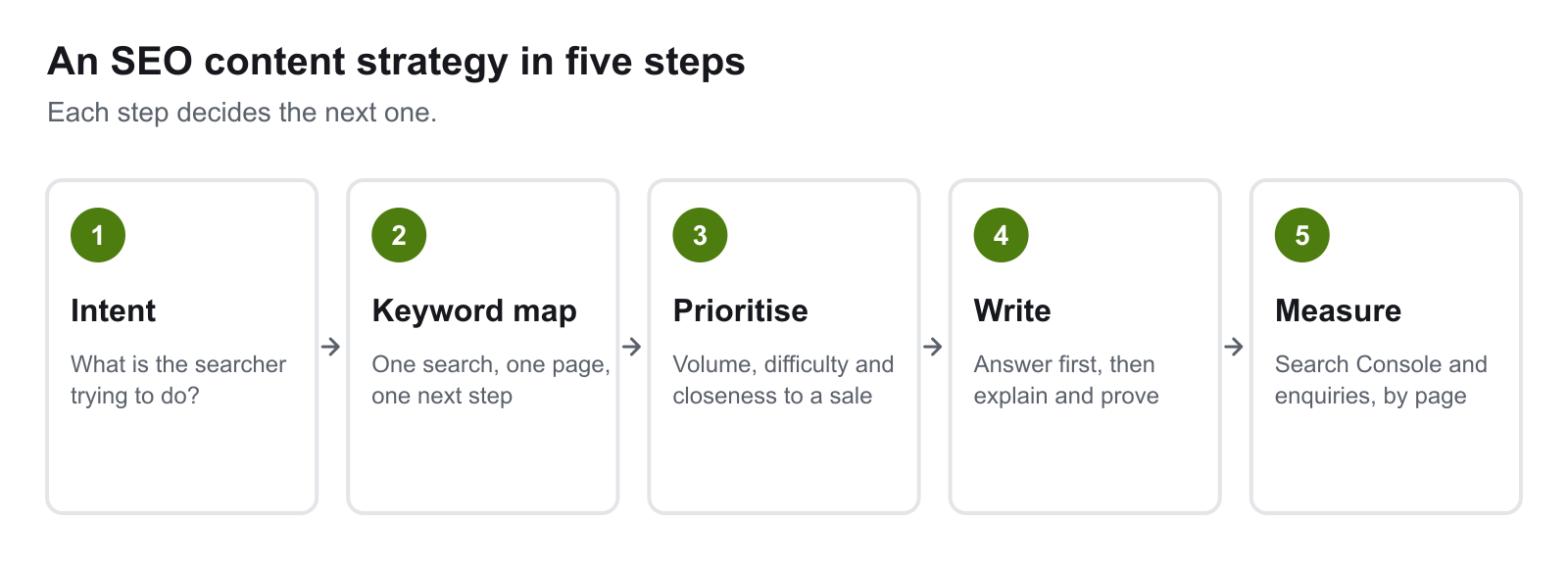
An SEO content strategy is a plan that answers three questions for every page before it is written:
- Who is it for, and what did they type into a search engine?
- What should the page contain to be the best answer to that search?
- What should the reader do next?
"Post consistently" is advice about quantity. A strategy is about which pages, in which order.
Step 1: Start with search intent
Every search has a purpose. The four types that keyword tools label are a useful way to sort them, because each needs a different kind of page.
| Intent | What the searcher wants | Example search | The page that fits |
|---|---|---|---|
| Informational | To understand something | "what is google ai mode" | An explainer or guide |
| Commercial | To compare options before choosing | "website design packages" | A comparison or buyer's guide |
| Transactional | To act now | "affordable web design perth" | A service or location page |
| Navigational | To reach a specific site | A business name | Your home page |
Two mistakes are common. One is writing only informational articles, which bring readers who are a long way from buying. The other is trying to rank an article for a transactional search, where search engines tend to show service pages.
Step 2: Build a keyword map, with one page per search
A keyword map lists each search you want to be found for, next to the one page that will answer it. For each row, record the search, how many people make it, how hard it is to rank for, the intent, and the page.
Here is part of our own, using Semrush figures for Australia from October 2026.
| Search | Monthly searches | Difficulty (0–100) | Intent | Page |
|---|---|---|---|---|
| small business web design | 1,000 | 25 | Commercial | A guide, linking to our service page |
| website design packages | 590 | 13 | Commercial | A comparison guide |
| technical seo checklist | 480 | 38 | Informational | A checklist |
| lead generation website | 210 | 38 | Informational | An explainer |
| affordable web design perth | 480 | 22 | Transactional | Our Perth page, not an article |
| website design | 9,900 | 76 | Commercial | Not targeted yet: too competitive for a new site |
Why one page per search
Two pages aimed at the same search compete with each other. We found this on our own blog. Search Console showed two of our articles appearing for the same searches about choosing an SEO agency, and an audit found two short posts covering the ground this guide now covers. We merged those two into this one and redirected the old address. One thorough page is easier to rank, easier to maintain and easier to link to than two thin ones.
Step 3: Prioritise by value and by what you can win
Not every search deserves a page yet. Score each row of the map on three things.
- Volume. How many people make the search.
- Difficulty. How strong the pages already ranking are. A new site is unlikely to win a search with a high difficulty score soon.
- Closeness to a sale. A search made by someone choosing a provider is worth more than a larger search made out of curiosity.
In the table above, "website design" has the most searches and is the wrong place to start. "Website design packages" has a fraction of the volume, a difficulty of 13 and a searcher who is about to buy. That is the page to write first.
Step 4: SEO content writing: how to write the page
Once the map says what the page is for, the writing has a clear brief.
Put the answer first
Open with two or three sentences that answer the search on their own. A reader who stops there should still have the answer. This is also the passage most likely to be quoted in an AI-written answer; our guide to AI search optimisation covers that in detail.
Use headings that match real questions
"Website speed factors" is a label. "What makes a website slow?" is what someone types. Headings written as questions help a reader skim and help a search engine match a section to a search. In a Nielsen Norman Group study, 79% of test users scanned a new page instead of reading it word by word (NN/g, 1997), so the headings do much of the work.
Make claims specific, and source them
"Improves performance significantly" tells the reader nothing. A figure with a named source does. If you cannot find a source for a number, leave the number out. We removed several unsourced statistics from our own older articles for this reason.
Cover the subject, then stop
Google states plainly that it has no preferred word count: "Are you writing to a particular word count because you've heard or read that Google has a preferred word count? (No, we don't.)" (Google Search Central). There are two ways to get length wrong.
- Too thin: the page mentions the subject without answering the question.
- Too padded: the answer is buried under filler added to reach a number.
Write until the reader would not need to search again, and no further.
Add what only you know
Google's guidance on AI search asks for "unique, expert or experienced takes that go beyond common knowledge and the ordinary" (Google). Your own prices, process, results and mistakes are the part of a page that cannot be copied.
Answer the follow-up questions
A short section of questions and answers helps readers who arrived with a slightly different question. Add it for them. Google removed the FAQ rich result from Search in 2026, so there is no search feature to gain from it.
Check it before publishing
Google's own self-assessment questions make a good final check.
| Google asks | What to look for |
|---|---|
| "Does the content provide original information, reporting, research, or analysis?" | Something that is yours: data, an example, a judgement |
| "Does the content provide a substantial, complete, or comprehensive description?" | The reader would not need to search again |
| "Does the content clearly demonstrate first-hand expertise and depth of knowledge?" | It is clear you have done the thing you describe |
| "Does the content present information in a way that makes you want to trust it?" | Sources linked, a date, a named author or business |
Can you use AI to write SEO content?
As a tool, yes. As a factory, no. Google's spam policies define scaled content abuse as "when many pages are generated for the primary purpose of manipulating search rankings and not helping users", and give "using generative AI tools or other similar tools to generate many pages without adding value for users" as an example (Google Search Central).
The test is the same as for any page: does it contain something of your own, and has a person checked every claim? Google's guidance also suggests telling readers how content was produced where they would reasonably want to know.
Step 5: Measure whether it worked
Use Google Search Console, which is free.
| What to look at | What it tells you |
|---|---|
| Searches each page appears for | Whether the page matched the intent you planned |
| Impressions | Whether the page is being shown at all |
| Average position | How close it is to the first page |
| Clicks | Whether the title and description earn the visit |
| Enquiries from that page | Whether the readers were the right ones |
Give it time. In the first three weeks after our own site was indexed, Search Console recorded 872 impressions and 6 clicks. One guide, on choosing a local SEO agency, accounted for 215 of those impressions. Numbers like that say where a search engine has started to test a site, and little more. Judge a content plan over months. Our write-up of our first six weeks of Search Console data shows how that played out.
Search Console also has a report for impressions in Google's AI features. Our guide to Google AI Mode explains what it shows.
When should you update old content instead of writing new?
Often. When we audited our own blog, six articles were under 900 words with no sources. We rewrote them, because thin pages do little for readers and can compete with better pages on the same subject.
Update a page when its facts have changed, when it has slipped in Search Console, or when it no longer answers the search as well as the pages above it. Change the published date only when the content has changed.
Do you need an SEO content service?
Not always. If you know your subject and can write clearly, the five steps above are within reach, and nobody else knows your business as well as you do. An SEO content service is worth paying for when you do not have the time, or when you cannot tell which searches are worth targeting.
Ask any provider for three things: the keyword map, with volumes and difficulty; who will check the facts; and how results will be reported. Our guide to choosing a local SEO agency has a longer list.
Want a content plan for your site?
Every SEO campaign we run starts with the keyword map: what your customers search for, what is winnable, and which pages you already have. Get in touch and tell us what you sell and where.
Work With wow.digital
If you would rather have this handled for you, these pages explain what we do and where we work:
Keep Reading
Frequently asked questions
What is an SEO content strategy?
An SEO content strategy is a plan for which pages to write, for which searches, in what order, and what each page should lead the reader to do. It starts from what your customers search for and how hard each search is to rank for, not from a list of topics that sound interesting.
What is SEO content writing?
SEO content writing is writing a page so that it fully answers the search it targets and is easy for people and search engines to read. In practice: the answer near the top, headings that match the questions people ask, specific claims with sources, and enough depth that the reader does not need to search again.
How long should a blog post be to rank?
As long as it takes to answer the question completely, and no longer. Google states that it has no preferred word count. A short page that answers a narrow question can outrank a long one that pads.
How much content do I need to publish to see SEO results?
There is no minimum. A small number of thorough pages, each aimed at a search your customers make, does more than a large number of thin ones. Several pages on the same subject can compete with each other and hold each other back.
Do keywords still matter for SEO?
Yes, as a guide to what people search for and the words they use. Repeating an exact phrase does not help. Write naturally about the subject, use the terms your customers use in the title and headings, and cover the related questions.
Can I use AI to write SEO content?
You can use it as a tool. What Google's policies target is scale without value: many pages generated mainly to manipulate rankings. Content needs something of your own in it, such as your figures, examples and judgement, and a person who checks every claim before it is published.